
Does bionic reading work? What the evidence says
Bionic reading bolds the first part of each word so the eye can jump between the bolded “fixation points” and the brain fills in the rest. The claim was that it makes you read faster. The largest test so far, with nearly two thousand readers, found no difference in speed or comprehension. That is not the end of the story, because speed was never the right question for the people who find reading hardest. Here is what the evidence actually shows, including for our own extension.
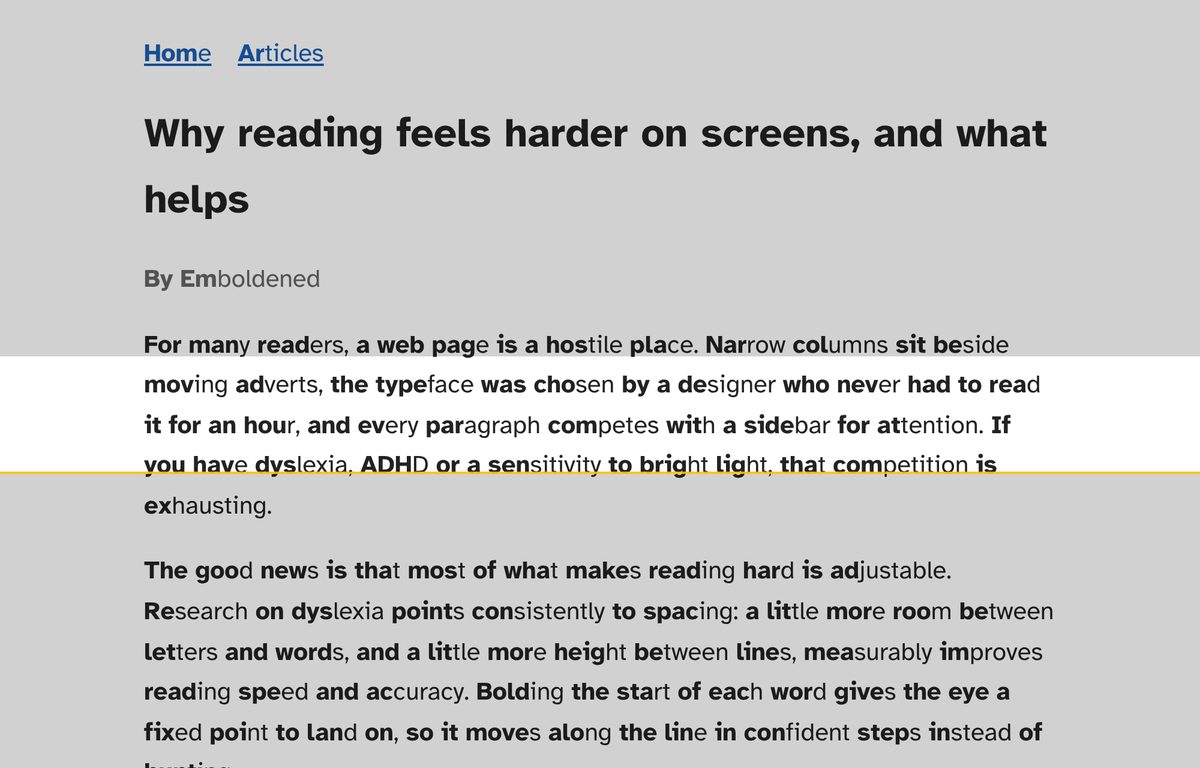
What bionic reading claims
Bionic Reading is a trademarked method from a Swiss company, launched around 2016 and widely noticed in 2022 when examples spread on social media. Its pitch is that bolding the first few letters of each word creates “artificial fixation points” that guide the eye, so reading becomes faster and more focused. Many tools now do something similar under other names, including Emboldened, which bolds the first syllable rather than a fixed number of letters.
The Readwise test: no effect on speed
In June 2022 the reading app Readwise ran an open online experiment, written up as “Does Bionic Reading actually work? We timed over 2,000 readers”. After removing duplicates and people who rushed, 1,916 participants each read two 1,000-word essays, with halves alternating between a plain font and the same font with bionic bolding, and answered comprehension questions after each half.
- Average speed was 325 words per minute with bolding and 328 without: a difference of under one per cent, not statistically significant.
- Comprehension was 88 per cent correct in both conditions.
- About half the participants read slightly faster with bolding and half slightly faster without, which is what you would expect from noise.
Readwise’s conclusion was blunt: bionic reading has no impact on reading speed. Their secondary observation is worth more than the headline, though: individual preference seemed to matter more than any single format.
This was not a peer-reviewed study, and participants were general readers, mostly without a reading difficulty. But it is by far the largest controlled comparison that has been published, and no study since has overturned it.
Why “faster” was the wrong question
For a fluent reader, the eye already lands roughly a third of the way into each word; typographers call this the preferred viewing position, and bolding the start of the word doesn’t change it. So a technique that promises to speed up fluent readers is promising to improve something that already works.
The people who use bolded word starts in practice are not fluent readers looking for a speed hack. They are readers with dyslexia, who lose their place inside long words; readers with ADHD, who lose their place between lines; and readers whose eyes are tired. For them the question is not “did I finish ten per cent sooner?” but “did I get to the end without re-reading the same line three times?” That is a question about effort and place-keeping, and the Readwise test did not measure it.
We should be honest: there is no large study showing that bolded word starts help those readers either. What exists is a consistent body of user reports, including from Emboldened’s own users, that the bolding makes words easier to “lock on to” and lines easier to track. That is evidence of a kind, but it is not the kind that lets anyone say “bionic reading works” as a general claim, and we don’t.
What the research does support for dyslexia
Two interventions that look superficially like bionic reading have real evidence behind them, and both concern spacing rather than bolding.
Letter spacing. Zorzi and colleagues, in a 2012 paper in the Proceedings of the National Academy of Sciences (summary), tested 94 Italian and French children with dyslexia aged 8 to 14. With extra-large spacing between letters, the children read about 20 per cent faster and made roughly half as many errors, with no training at all. The proposed mechanism is “crowding”: letters next to each other interfere with recognition, and dyslexic readers are more affected by it. Wider spacing reduces the interference.
Line spacing and layout. The British Dyslexia Association’s Dyslexia Style Guide recommends sans serif fonts at 12 to 14 point, line spacing of about 1.5, wider letter and word spacing, left-aligned text, and an off-white rather than pure white background. These are practical recommendations drawn from the Association’s experience rather than a single trial, but they are what UK schools, universities and employers are asked to follow.
Fonts. Rello and Baeza-Yates tested 48 dyslexic readers across a dozen fonts in “Good Fonts for Dyslexia” (2013), measuring reading time with eye tracking. Sans serif, roman (non-italic) fonts performed best; italics hurt; and the specially designed OpenDyslexic did not improve readability or speed, with readers preferring Verdana and Helvetica. The lesson is that plain, familiar, well-spaced type beats special shapes.
What this means for how Emboldened is built
Emboldened started as a bolding tool, and bolding is still free and still the first thing you see. But the research is why the settings that come next are spacing: separate sliders for letter, word, line and paragraph spacing, in the ranges the BDA guide describes, and three bundled fonts chosen for legibility (Atkinson Hyperlegible, Lexend and OpenDyslexic, the last one because many people have already learned to read with it and familiarity matters).
Two differences from Bionic Reading’s method are deliberate. Emboldened bolds the first syllable, found with a 139,000-word syllable dictionary, rather than a fixed fraction of letters, so un·der·stand and read·ing are split where the word actually breaks. And it never changes the text: the bolding is applied on top, so copying still gives you the original words, and switching it off restores the page exactly.
If you want to try the approach, Emboldened is free to install from the Chrome Web Store, and the free tier is enough to find out whether bolded starts help you personally, which, as Readwise found, is the only test that counts.
How to test it on yourself
- Pick a long article you have not read.
- Read the first half with bolding off, the second half with it on (or the other way round), timing each.
- Ignore the time. Ask instead: how many times did you lose your place? How tired are your eyes? Would you rather read the next article with it on or off?
- Repeat with spacing on. For most readers with dyslexia, that is the one that changes the answer.
Questions
So bionic reading is a myth?
The claim that it makes people read faster is not supported by the best available test. The claim that some readers find bolded word starts easier to track is supported by consistent reports but not by a large study. Those are different claims; the first is marketing, the second is a personal preference you can test in five minutes.
Is Emboldened the same as Bionic Reading?
No. Bionic Reading is a trademarked method and company. Emboldened is an independent extension that bolds first syllables (not a fixed number of letters), and whose main evidence-based features are spacing, fonts, a reading ruler and read-aloud. See Emboldened vs Bionic Reading.
What has the strongest evidence for dyslexia?
For on-screen text: letter spacing (Zorzi et al., 2012), plain sans serif fonts without italics (Rello & Baeza-Yates, 2013), and the BDA style guide’s layout advice. For reading itself, structured phonics teaching, which no extension replaces.
Does bolding help with ADHD?
There is no specific study. Users with ADHD tend to describe bolding as a place-keeping aid rather than a speed aid, and often pair it with a reading ruler, which has a clearer rationale: it hides everything except the current lines.
Free to install. Every Pro feature is on for 14 days, no card. Nothing you read leaves your computer.